
Posts

Newcrest Mining Orders Cave Tracker System for its Cadia East Mine

Cave Tracker System

Newcrest Mining will install a large-scale Cave Tracker System at its Cadia East mine in New South Wales.

Developed and manufactured by Brisbane-based Elexon Mining, the Cave Tracker System was conceived in collaboration with Newcrest, CRC Mining and Rio Tinto. Newcrest hosted the earliest trials of the prototype system at its Ridgeway Deeps mine.

Elexon Mining Product Manager Simon Steffen said, “The Cave Tracker System is a big step forward for the mining industry. It will enable mining companies to improve their capabilities to successfully ramp-up and operate cave mines, maximising safety and economic outcomes.”

“Newcrest’s order is another step forward for Elexon, proving that a collaborative approach to product development delivers innovative and value-adding solutions. Elexon is expecting that the world leaders in caving, Rio Tinto and Newcrest, will lead the way to higher performing cave projects through embracing innovative products such as Cave Tracker.”

Cave Tracker provides a real-time insight into cave flow and cave propagation. This insight closes a feedback loop that was not previously available. Cave Tracker greatly enhances a mine operator’s ability to proactively manage risks of cave mine projects.

IMAGES

image-3-web

Dylan Whiteman and Simon Steffen with a crate load of Cave Tracker beacons destined for Newcrest’s Cadia East mine.

image-1-web

Some of the Elexon Mining team: John Ruys, Jared Millane, Dylan Whiteman, Simon Steffen
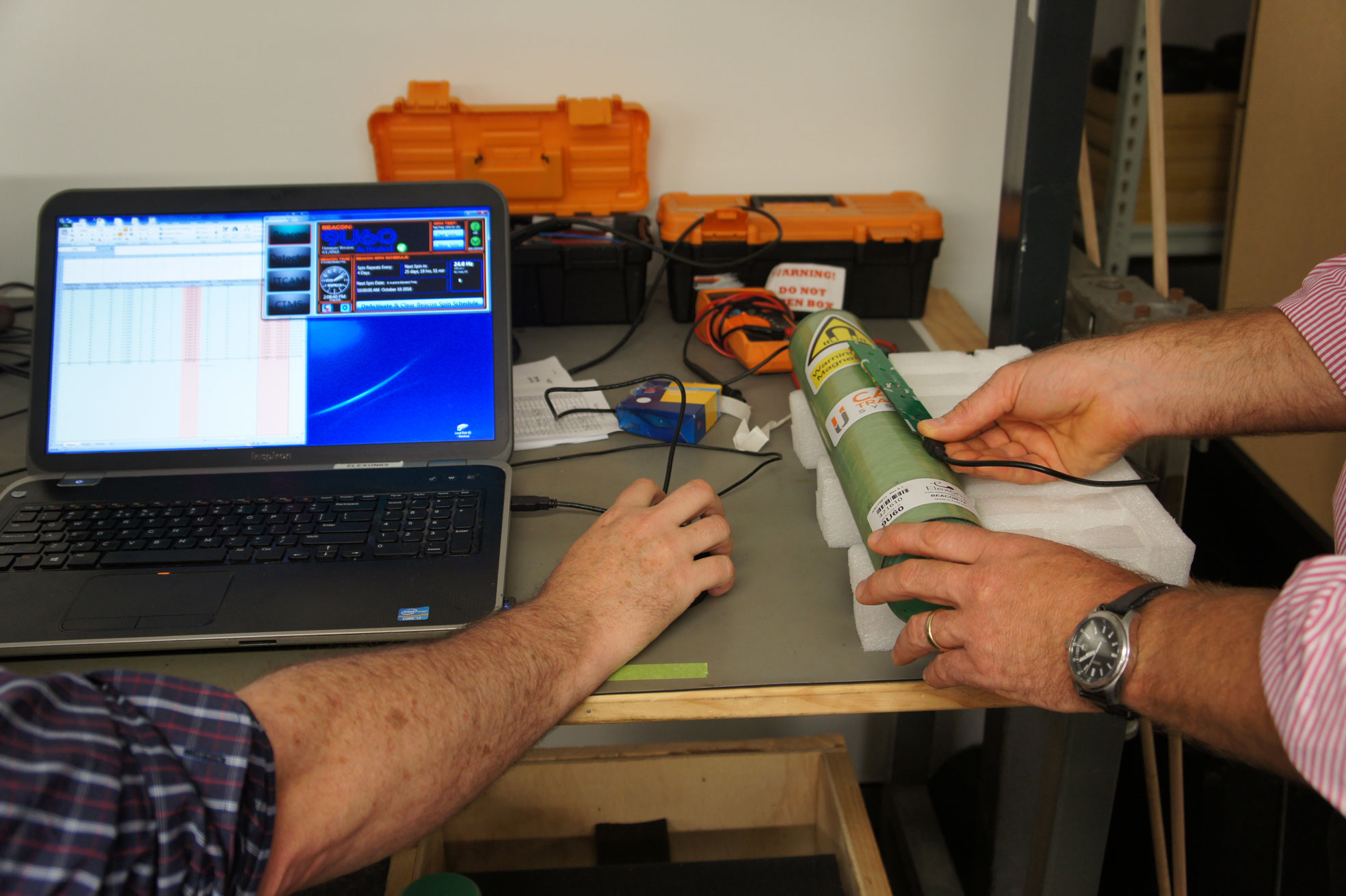
image-2-web

Cave Tracker system being activated

About the Cave Tracker System
The Cave Tracker System enables mines to more accurately determine the extent of the cave and track ore flow. Through the data gathered with the Cave Tracker System, the Mine Management team are able to make better decisions to protect the mine asset and keep it working as it should; safely and efficiently. The system operates through a series of beacons that are embedded in the mine, which can be tracked in 3D as they move with the fragmented rock of the ore-body. The data generated from Cave Tracker allows the Mining and Geotechnical Engineers to determine which parts of the cave are moving and which parts are not, and make proactive changes accordingly. The rate and direction of movement can also be established. Read more HERE.

About Elexon Mining
Elexon Mining is a Brisbane-based technology company that develops innovative geotechnical monitoring systems for underground and open pit mines. Elexon Mining’s products enable mines to better manage geotechnical risks that can impact safety and productivity in mining operations through enhanced understanding of ground movement.
Elexon Mining is a division of Elexon Electronics.
Website: www.elexonmining.com

About Newcrest Mining
Newcrest is one of the world’s largest gold mining companies and operates mines in four countries.

Newcrest’s mission is to deliver superior returns from finding, developing and operating gold/copper mines. Our vision is to be the Miner of Choice™.

We will lead the way in safe, responsible, efficient and profitable mining.

Website: www.newcrest.com.au

About CRC Mining
CRC Mining is an industry-driven, global leader in mining research and innovation. We develop and deliver breakthrough innovation and technologies that transform the productivity, sustainability and safety of the mining industry. CRC Mining partners with universities and mining companies to collectively drive innovative development. These developments involve new and modified mining methods and processes, new mining technology and equipment. We accelerate commercial outcomes from research, and ensure they are available to the industry as rapidly and effectively as possible.

Note: from October 2016 CRC Mining announced a new operating name and structure – Mining3.

Website: www.mining3.com

New cave system improves mine safety and productivity

Cave Tracker System

Mining projects can be dangerous jobs that are difficult to manage, and when things go wrong, the consequences can cost millions.

But a new system is tackling both safety and productivity, which could have gains both in Australia and overseas.

The Cave Tracker has been developed by Elexon Mining in conjunction with CRC Mining, Rio Tinto and Newcrest, to enhance critical monitoring in block caving projects where miners go beneath an ore body and undercut it.

This requires blasting a segment out from under the ore body, which removes the support for the rock that’s above it. As ore is removed, gravity pushes down fragments to the undercut area where it can be collected.

As miners are unable to see into the ore body, it is hard to predict ore flows and manage the mine.

But the Cave Tracker system is looking to change that through the use of beacons that are installed into the ore body. These wireless beacons can then be tracked in 3D by detectors as they move through the mine as the ore is drawn to the bottom.

Beacon prototype

The cylindrical beacons measure 76 mm wide and about 33 cm long and are made of fibreglass to withstand the harsh environment of underground mines.

But the first beacon prototype was not designed to survive the force of a cave but to test the locating technology. Instead, Elexon Mining had access to holes in a mine where it lowered the first prototypes down on rope and recovered them again.

“They weren’t exposed to massive forces like the ones we have now. The prototype was pretty simple and probably quite far away from what we’ve got now,” said Simon Steffen, product manager at Elexon Mining.

The initial beacons measured much wider at 135 mm in diameter, but due to constraints on mine sites and the cost of drilling holes of that size, the beacons were downsized to its current 76 mm.

The newest generation beacons comprise a spinning magnet, electronics for controlling the motor and a battery pack, which has a lifespan of up to 10 years.

“We had to make sure the forces of the rock in the cave didn’t destroy the beacon, its housing, the electronics and the spinning element. From a mechanical point-of-view, this was very challenging,” Steffen said.

Elsewhere in the mine, detectors are installed deep around the mine and can detect signals between 160 m and 210 m away. It then collects this information via a cable to a central system where the data can be stored and analysed.

The system also works in near real time, which enables operators to analyse if material is traveling down according to plan, is moving in an accelerated fashion or whether there are areas that aren’t moving. This insight allows them to optimise ore recovery and minimise waste.

The system also has flow-on effects that improve safety by detecting areas that aren’t moving.

“If [the mine is] not propagating to plan and the cave stalls … it can create what’s called an air gap, which means they extract material that’s broken but no new material is flowing down from above, which creates a void,” Steffen said.

“If the rock above the void collapses at some point, it can displace a huge amount of air, which can have critical safety implications.”

Software prediction

The system has undergone two trials – the first at Newcrest’s Ridgeway underground mine and the second at Rio Tinto’s Argyle diamond mine.

In the first trial, Elexon deployed a small number of beacons. A small number of issues were identified and resolved, while the second trial deployed a larger number of beacons.

“It was really interesting … to actually compare measured locations of devices in the cave with modeling software prediction. To get these lined up was really good,” Steffen said.

“Also, from a technology point-of-view, we were happy that the beacons performed really well. There were a few beacons that failed, which we expected as a first-generation prototype.

“The number of failed beacons was relatively small and we investigated potential causes, which we followed up. Now with the next generation, we’ll hopefully have resolved most of these issues.”

Some of those potential issues included a software bug, but Steffen said as the beacons can’t be recovered once they’re in the ground, it can be diffciult to see what actually happened.

Elexon Mining is now a semi-finalist in the Australian Technologies Competition, and the system is still currently running at the Argyle mine. Another a system is also scheduled to be delivered to Newcrest. Rio Tinto also plans to use it in its cave mining operations at Oyu Tolgoi in Mongolia.

“In the scale of the mining projects we are looking at, where costs and revenue are in the multiples of billion dollars, the economic value of [this system] is potentially huge,” Steffen said. “Even small improvements can have a big effect on the bottom line.”

[Image: Screengrab from the Cave Tracker video courtesy Rio Tinto, Elexon and CRC Mining]

This article was originally published by Engineers Australia. Original article can be found HERE.